About Ion Exchange Column
Ion Exchange Column:
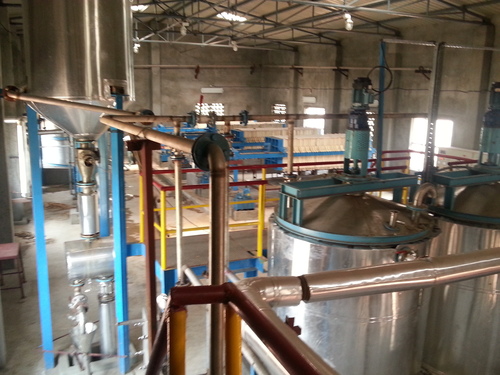
The pre-concentrated glucose syrup is passed through the common regeneration ion exchange column to refine glucose syrup by deashing. It is used to remove residual flavour and color bodies that were either missed during carbon refining or were not abosorbed by the activated carbon present in the syrup. It also removes ash (solubel salts) and all the organic and inorganic impurities from glucose syrup.
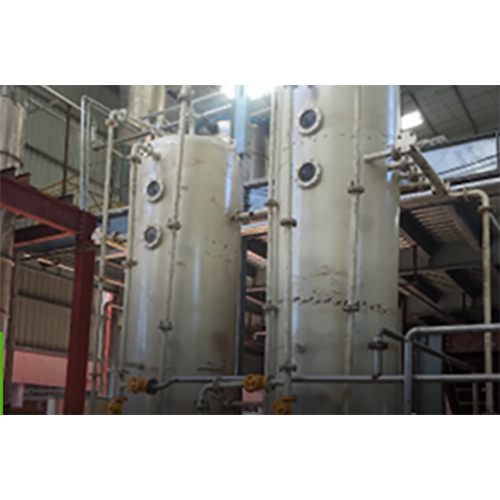
It has two column one is anion exchange & another is cation exchange made of ISMS 226 with food grade rubber lined or AISI 304 or AISI 316. Columns are filled with suitable resins and the syrup is passed through it, resins has to be regenrated from time to time.
Advantages
Impurities will be removed Like:
 Organic and inorganic acids
 - Heavy metals
- Ash contents
- Alkaline earth metals
- Improved product
- Improved stability
Durable and Efficient Water TreatmentEmploying premium-grade FRP material, the Ion Exchange Column ensures longevity, robust chemical resistance, and consistently high performance. Its smooth surface minimizes scaling and fouling, meaning reduced maintenance and longer service life. With a capacity of 1000 liters and ability to operate across a broad temperature range, it is a cost-effective solution for various industrial water treatment needs.
Versatile Operation & Easy InstallationThis column features a vertical design with both flanged and threaded end connections, accommodating diverse installation environments. It is suited for water softening and demineralization processes, equipped with either strong acid cation or strong base anion resin. The manual valve control system is intuitive to operate, making it accessible for skilled and minimally trained personnel alike.
FAQs of Ion Exchange Column:
Q: How should the Ion Exchange Column be installed for optimal performance?
A: The column should be installed vertically on a flat, stable surface with proper access to the feed and discharge connections. Ensure the chosen location allows secure connection to inlet and outlet pipes, using either flanged or threaded fittings, as required. Standard installation practices and adherence to manufacturers guidelines will ensure optimal operation.
Q: What is the typical process flow through this Ion Exchange Column?
A: Raw water enters the column through the inlet at the top or side, flowing downward through the ion exchange resin bed (either strong acid cation or strong base anion, depending on the application). Unwanted ions in the water are exchanged with ions in the resin, effectively softening or demineralizing the water, which then exits through the outlet.
Q: When is resin replacement or regeneration required?
A: Resin should be regenerated or replaced when there is a noticeable decline in treated water quality or an increase in pressure drop across the column. Regeneration frequency depends on water quality and usage but typically occurs once the resins ion exchange capacity is exhausted, which can be tracked through scheduled maintenance and periodic water testing.
Q: Where can this Ion Exchange Column be effectively utilized?
A: The column is ideally suited for industrial, commercial, and municipal water treatment facilities requiring water softening or demineralization. Due to its chemical resistance and corrosion-proof construction, it is suitable for various process water and boiler feed applications in sectors like manufacturing, food processing, and pharmaceuticals.
Q: What are the benefits of using an FRP-based ion exchange column?
A: FRP (Fiber Reinforced Plastic) provides excellent chemical resistance against aggressive media, prevents corrosion, and delivers a smooth surface to reduce scaling. This results in long service life, reduced maintenance frequency, and improved overall reliability compared to conventional materials.
Q: How is the column controlled and does it require electrical power?
A: The column uses a manual valve control system, eliminating the need for electrical power. Operators simply turn valves to regulate flow and initiate processes such as service, backwash, and regeneration, as required.
Q: What usage advantages does the semi-automatic design offer?
A: The semi-automatic design gives users hands-on control with straightforward manual operation, making the system easy to maintain and minimizing operational complexity. This not only reduces upfront and ongoing costs but also ensures reliable function in areas lacking advanced automation infrastructure.


 Send Inquiry





 Send Inquiry
 Send Inquiry
 Send SMS
 Call Me Free


