Falling Film Evaporator About
Falling Film Evaporator
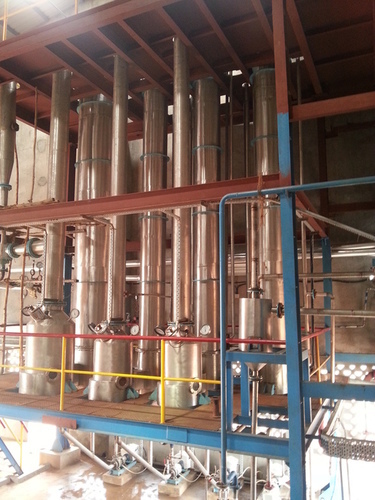
A falling film evaporator is used in industries to concentrate liquid especially heat sensitive materials In this type of evaporators the liquid is feed from the top of the evaporator design of the product distribution system in the evaporator is such that the product wetting of the tubes should be full and evenly.
The product is distributed into the heating tubes in a form of thin layer and it flows downwards at boiling temperature and start evaporating.
The product and the vapors goes into the separator where the both is separated and vapors is forwarded to next effect. This type of evaporators can be operated with very low temperature differences between the heating media and the liquid. The effect of this type evaporator depends of the capacity and type of product. While designing number of effect is calculated considering steam economy and cost.
Applications
 Glucose/Dextrose/Maltose/Fructose
 - Milk
- Honey
- Fruit Juices
- Tomato Juice
- Malt Extract
- Sugar Cane Juice
- Invert Sugar
- Coffee Extract
- Tea Extract
- Herbal Extract
- Soy milk
- Tea extract
- Distillery Waste
- Tea Extract
- Water Effluent etc.
Chemical & Pharmaceuticals
- Salt
- Enzymes
- Gelatine/Glue
- Sodium Sulphate
- Dye
- Effluent
- Caustic Soda
- Phosphoric Acid etc.
Efficient Multi-Effect EvaporationFalling Film Evaporators utilize single, double, or multiple effect setups, enabling substantial energy savings and improved evaporation rates. By leveraging steam heating and optimized condenser types, these systems maximize solvent removal while minimizing operational costs. Their application versatility across food, chemical, pharmaceutical, and dairy industries makes them an invaluable resource for liquid concentration needs.
Automatic Operation and Advanced ControlsThe system features a PLC-based control panel ensuring precise, consistent process management. Its automatic operation minimizes manual intervention, boosting reliability and safety. Computerized monitoring allows users to easily adjust settings and observe performance, ensuring optimal results for diverse feed consistencies and production requirements.
Hygienic Design and Easy MaintenanceConstructed from polished stainless steel with CIP-compatible cleaning, the Falling Film Evaporator supports high hygiene standards vital for sensitive industry sectors. The design enables swift cleaning-in-place, reducing downtime and ensuring product integrity. Its robust build and dependable service life make it a cost-effective choice for businesses looking for durability and ease of upkeep.
FAQs of Falling Film Evaporator:
Q: How does a falling film evaporator benefit industries like food, chemical, and dairy?
A: The falling film evaporator offers efficient concentration of liquids while minimizing energy consumption. Its versatile design accommodates low to medium viscosity feeds, making it ideal for food, chemical, pharmaceutical, and dairy processing, where maintaining product quality and throughput is essential.
Q: What is the process for cleaning a falling film evaporator, and is it CIP compatible?
A: These evaporators are designed for Clean-In-Place (CIP) cleaning, enabling automated cleaning cycles using minimal manual intervention. This ensures consistent hygiene, reduces downtime, and maintains safe operation, which is crucial in industries with strict sanitary requirements.
Q: When should multiple-effect configurations be selected over single or double effect?
A: Multiple-effect configurations are recommended when higher evaporation rates and lower energy consumption are required. They are especially beneficial for large-scale operations or applications demanding enhanced efficiency, typically in industries where reducing steam consumption is crucial.
Q: Where can falling film evaporators be installed, and what are the installation options?
A: Falling film evaporators can be installed on-site (field erection) or as skid-mounted units, offering flexibility based on space and operational needs. This adaptability makes them suitable for new plants as well as upgrades in existing facilities.
Q: How does the PLC-based control system enhance operation and process accuracy?
A: The PLC-based control system automates process parameters, providing precise control over evaporation and feed rates. It ensures safety, consistency, and easy adjustments, making operation straightforward and reliable, which is especially advantageous for continuous production environments.
Q: What types of condensers are available with these evaporators and why are they important?
A: Falling film evaporators come with Shell & Tube or Surface Condenser options. Choosing the suitable condenser type ensures efficient condensation and greater vapor management, improving overall system performance and energy efficiency.
Q: What are the advantages of using stainless steel construction in falling film evaporators?
A: Stainless steel construction provides excellent corrosion resistance, long service life, and a polished surface finish, ensuring high hygiene standards and reducing contamination risk. It is particularly important for food and pharmaceutical applications.

 Send Inquiry


 Send Inquiry

 Send Inquiry


